
I. Zanim rozpoczniesz opracowanie materiału przypomnij sobie informacje na temat ukształtowania się we Francji monarchii stanowej. W tym celu możesz wykorzystać poniższy film (uruchomi się we właściwym miejscu):
II. Absolutyzm – forma rządów, polegająca na skupieniu władzy w rękach panującego monarchy, którego władza nie podlega niczyjej kontroli.
Absolutyzm we Francji zawdzięczamy reformom kardynała Armanda Richelieu – pierwszego ministra Ludwika XIII. Ostatecznie Francja stała się monarchią
absolutną za panowania Ludwika XIV.
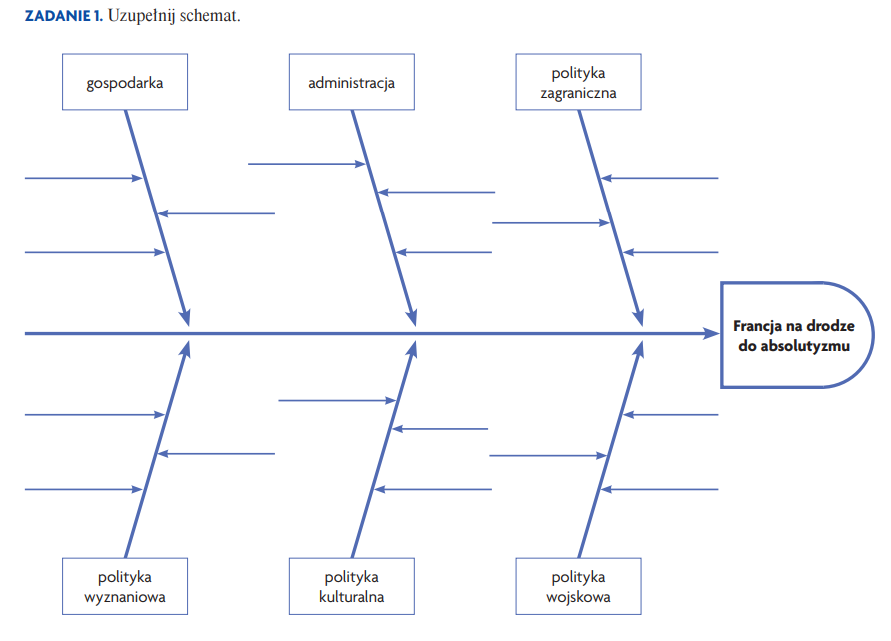
III. Zapoznaj się z treścią podręcznika, a następnie przejdź do wykonania karty pracy. Twoim zadaniem jest opracowanie w formie hasłowej głównych czynników, które doprowadziły do ukształtowania się monarchii absolutnej we Francji. Do każdej „ości” dopisz działania podejmowane we Francji.
Po zakończonej pracy przepisz notatkę lekcyjną:
NOTATKA

Absolutism in France
Absolutism – a form of government where all power is concentrated in the hands of the ruling monarch, whose authority is not limited or controlled by any other institution.
Absolutism in France developed thanks to the reforms of Cardinal Armand Richelieu – the first minister of King Louis XIII. Under the reign of Louis XIV, France became a truly absolute monarchy.
1. Religious Wars in the 16th Century
In the 16th century, France was torn apart (rozdarty) by religious wars. On the night of August 23–24, 1572, the St. Bartholomew’s Day Massacre took place – a brutal slaughter (rzeź, wymordownie) of the Huguenots (French Calvinists).
To end the religious conflicts, Henry IV of Bourbon issued the Edict of Nantes (1598), which granted religious freedom to Protestants in France, except in Paris, where Protestantism remained banned (pozostał zakazany).
2. The Reign of Louis XIII and the Reforms of Cardinal Richelieu
The regency of Marie de’ Medici – the country falls into crisis.
Cardinal Richelieu, known as the „Grey Eminence,” strengthened royal power through several key measures (kluczowe działania):
a. The defeat of the Huguenots, followed by granting them freedom of worship (kult) (Edict of Grace, 1629) – religious tolerance.
b. Reducing the influence of the aristocracy.
c. Acting according to the principle of raison d’état =national interest – the interests of the state come before all else.
d. Stopping the meetings of the Estates-General (the French parliament established during the feudal monarchy *1302 – first convened by King Philip IV „Philip the Fair”).
e. Developing domestic production and supporting mercantilism – an economic doctrine claiming that a nation’s wealth depends on the growth of craftsmanship and trade.
3. The Reign of Louis XIV – the Sun King, “L’État, c’est moi” (“I am the state”)
Regency of Anne of Austria: she ruled on behalf of the underage king with Cardinal Jules Mazarin as a prime minister. The period of internal unrest (niepokoje wewnętrzne) – the Huguenots and the nobility tried to regain their former privileges.
1643–1645 – Peasant uprisings.
1648–1649 – The Parliamentary Fronde: The French Parliament tried to limit royal power. It was a rebellion against Cardinal Mazarin and royal authority during the Thirty Years’ War.
1649–1653 – The Fronde of the Princes: An aristocratic revolt against absolute monarchy.
a. The expansion of Versailles – allowing control over the aristocracy by keeping them at the royal court.
b. Economic reforms by Jean-Baptiste Colbert: the promotion of mercantilism, the development of the navy (marynarka wojenna, flota morska), colonial expansion, and tax reforms.
c. The revocation (zniesienie, unieważnienie) of the Edict of Nantes (1685) – which led many Huguenots to flee (opuszczać)the France.
d. A flourishing of culture, especially art and architecture.
e. Expansion of French territory.